









Blog
Funded Trader Programs in Forex: What They Are, How They Work, Requirements, and Payouts


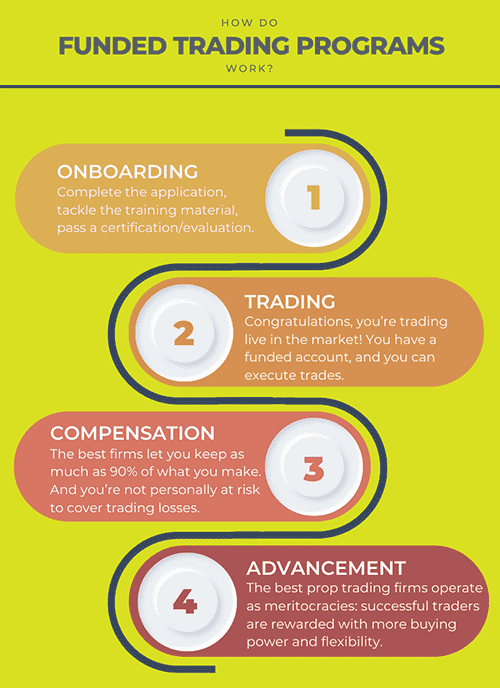
Funded trader programs in Forex are arrangements where proprietary trading firms give skilled traders access to firm capital after they pass an evaluation challenge, allowing them to trade without risking personal money while sharing profits. These programs solve a key problem for traders: limited capital. Firms like FTMO or The Funded Trader spot talent through simulated challenges, then provide accounts from $10,000 to $2 million. Traders pay a one-time fee for the challenge, prove consistency, and earn 70-90% of profits on live accounts. This setup has grown popular since 2020, with thousands joining yearly.
Requirements typically include being at least 18 years old, paying a challenge fee of $100 to $1,000, and following strict risk rules like daily drawdown limits of 4-5%. No college degree or certification is needed; skills matter most. Programs verify identity and ensure compliance with basic laws.
Payouts come bi-weekly or monthly, with traders keeping most profits after hitting minimum trading days. Firms handle withdrawals via bank transfer or crypto, often starting at $50 minimums.
Many wonder if these programs suit beginners. They offer a path to professional trading, but success demands discipline. Now, let’s break down each part in more detail.
What Are Funded Trader Programs?
Funded trader programs are proprietary trading firm initiatives that provide traders with firm capital to trade Forex after passing skill-based evaluations, aiming to identify and reward consistent performers without traders using their own money. Specifically, these programs emerged in the prop trading space around 2015 to bridge the gap between retail traders and institutional funding.
In detail, funded trader programs work by firms posting challenge accounts on platforms. Traders buy access, trade in demo-like environments mimicking live markets, and meet targets. Once funded, traders operate real accounts under firm oversight. Key features include profit sharing, where traders get 80% on average, and scaling up to larger balances based on performance.
You’ll notice these programs focus on risk management over raw profits. Firms use algorithms to monitor trades in real-time, enforcing rules to protect capital.
How Do Funded Trader Programs Differ from Traditional Brokerage Accounts?
Funded programs shift all capital risk to the firm, unlike traditional brokerage accounts where traders risk their own deposits. In a standard broker setup, you fund your account with $1,000-$10,000 and face full losses on bad trades. Funded accounts start risk-free post-challenge, with firms covering losses up to drawdown limits.
For example, with brokers like IG or OANDA, leverage amplifies gains and losses on your money. Funded programs cap leverage at 1:100 and ban high-risk strategies, prioritizing survival.
Another difference lies in profit access. Brokers let you withdraw anytime, but funded firms require minimum days traded and consistency checks before payouts.
Traders often ask, why choose funded over brokers? The answer is scale: access $200,000 without personal capital, turning a $500 challenge fee into life-changing income if skilled.
Pros of funded programs include mentorship communities and analytics tools not always free at brokers. Data from prop firm reviews shows 10-20% pass rates, but passers average $5,000-$20,000 monthly payouts.
In contrast, retail trading sees 70-80% losing money per broker disclosures. Funded programs filter for winners early.
This structure suits Forex pairs like EUR/USD, where volatility tests discipline.
How Do Funded Trader Programs Work?
Funded trader programs operate through a three-stage process: pay for an evaluation challenge, pass profit and risk targets, then trade a live funded account with profit splits. Here’s the breakdown of the operational flow.
The process starts with selecting a firm like FTMO or FundedNext. You choose account size, say $50,000, and pay $300 fee. Trade for 30-60 days in phase one.
Phase two, if offered, repeats with stricter rules. Passing unlocks the funded stage.
Let’s explore the evaluation challenge next.
What Is the Evaluation Challenge in Funded Programs?
The evaluation challenge is a simulated trading period where traders must hit a 8-10% profit target without exceeding 5% daily or 10% total drawdown limits. Specifically, it lasts 10-30 minimum days, using demo accounts with real market data.

5 Key Facts About Funded Trading Account
For instance, on a $100,000 challenge, aim for $10,000 profit while keeping losses under $5,000 daily and $10,000 overall. Firms track every trade via platforms like MetaTrader 5.
Main point one: profit targets ensure skill, not luck. Evidence from firm stats shows consistent 1-2% monthly returns pass most.
Main point two: drawdown rules teach risk control. Breach them, and the account resets or fails, protecting firm capital.
Main point three: no time limits in some programs let patient traders shine. Tools like trade copiers are often banned to verify personal ability.
Traders report practicing on free trials first. Success rates hover at 15%, per industry forums.
What Happens After Passing the Challenge?
After passing, traders receive a live funded account, start with 70-90% profit splits, and can scale up to $2 million based on milestones. Detailed content follows.

You sign a contract, get credentials for a live broker like Eightcap. Trade normally, but follow ongoing rules.
For example, first payout after 14 days if profitable. Firms review for rule adherence.
Profit splits begin at 80/20 (trader/firm), rising to 90/10 with good performance. Scaling adds 25% balance every four months.
Many scale from $50,000 to $400,000 in a year. Payouts via Rise or Deel, processed in 24-48 hours.
Psychologically, the shift to live trading brings real pressure, but tools like equity protectors help.
Firms offer add-ons like loyalty programs for faster withdrawals.
This stage rewards longevity, with top traders earning six figures annually.
The full process takes 1-3 months to fund, then ongoing management.
What Are the Requirements to Join a Funded Trader Program?
Requirements include being 18+, paying challenge fees from $50-$1,000, verifying ID, and agreeing to risk rules like 4-6% daily drawdown caps. To understand this better, entry focuses on affordability and basic compliance.
Programs from SurgeTrader to True Forex Funds list these universally. No net worth proof needed.
Capital for fees is key; smaller accounts cost less.
Now, specific trading rules.
What Trading Rules Must Traders Follow?
Traders must adhere to max daily loss of 4-5%, total drawdown of 8-12%, minimum 5-10 trading days per phase, and bans on news trading or martingale strategies. Specifically, these prevent blowups.

What Is the Evaluation Challenge in Funded Programs?
For example, daily drawdown calculates from highest equity peak. Hit 5% loss, account closes.
Main point one: overall drawdown trails from initial balance. Keeps firms safe.
Main point two: min days force consistency over gambles. Evidence: passers average 20-30 trades per challenge.
Main point three: strategy limits like no holding over weekends in some firms promote discipline.
Violations trigger instant breach. Platforms auto-enforce via EAs.
Rhetorical question: ever blown an account? These rules train you not to.
Do Funded Programs Require Prior Trading Experience?
Funded programs emphasize proven skills shown in challenges over past experience. No formal experience is required; anyone passing proves ability through targets. Platforms welcome newbies with education.

Defining the Key Challenges in Funding Evaluation
Skills like chart reading matter, but firms provide simulators.
Many start with demo practice. Stats show 40% of passers have under one year live trading.
Benefits include community discords for learning.
What Are the Benefits of Funded Trader Programs?
Key benefits include trading large capital up to $2 million risk-free, high profit shares of 80-90%, and account scaling for growth. Let’s see why Forex traders flock to them.
First, capital access changes everything. With $200,000 funded, a 1% daily move on EUR/USD nets $2,000 versus $20 on personal $2,000.
No personal risk means sleep better after losses. Firms absorb up to drawdown limits.
Scalability lets winners grow: hit 10% profit quarterly, get 25% bigger account.
Communities offer signals, webinars. Firms like My Forex Funds provide psychology coaching.
Payout reliability builds wealth; consistent traders withdraw $10,000+ monthly.
Tax perks in some jurisdictions treat income favorably.
Versus retail, lower spreads on firm brokers save thousands yearly.
Ever dreamed of quitting your job? Top 5% do, per trader testimonials.
Flexibility: trade from anywhere, any session.
Long-term, builds resume for hedge funds.
Draw: fees recouped fast on success.
Overall, democratizes pro trading for skilled individuals.
What Are the Payout Structures in Funded Trader Programs?
Payout structures feature bi-weekly or monthly withdrawals, 70-90% trader splits, and minimums starting at $50 after 5-14 trading days. In detail, rewards tie to performance.
Firms process via bank, PayPal, or crypto. No caps on top earners.
H3 details follow.
How Are Profits Split Between Trader and Firm?
Profits split 70-90% to the trader and 10-30% to the firm, with increases for consistent performance like hitting scaling targets. Specifically, starts at 80/20, boosts to 90/10 after three payouts.

For instance, $10,000 profit on $100,000 account means $8,000 to you.
Main point one: performance tiers reward loyalty. FTMO data: 85% average split.
Main point two: no profit caps; scale to millions.
Main point three: transparency via dashboards tracks entitlements.
This motivates long-term trading.
What Are the Withdrawal Rules for Funded Accounts?
Withdrawals require proof of trades, minimum 5-10 days active, and no recent breaches, with processing in 1-7 days. Detailed note: submit tickets with screenshots.

For example, bi-weekly on Fridays if eligible.
Main point one: volume mins ensure activity, like 0.5 lot per $10,000.
Main point two: KYC once upfront speeds repeats.
Main point three: crypto options for speed, fees low.
Delays rare post-verification.
What Are the Risks of Funded Trader Programs?
Risks involve losing challenge fees on 80-90% failure rates, account breaches from rule slips, and psychological stress from pressure. Potential downsides need addressing.
First, fees: $500 lost if fail, non-refundable. Multiple tries add up.
Breaches happen fast; one bad day ends it.
Pressure mimics live stakes, causing tilt.
Firm changes: some shut down like My Forex Funds in 2023.
Scams exist; stick to regulated like Leet Pro.
Over-reliance skips personal growth.
Stats: only 10% sustain six months.
Mitigate with practice, small starts.
Question: worth the gamble? For disciplined, yes.
Balance with personal accounts long-term.
What Else Should You Know About Funded Trader Programs?
Funded trader programs include advanced rules on news trading, scaling options, tax treatments, and low success rates that affect trader selection and long-term viability.
Furthermore, understanding these elements helps traders pick the right program and avoid common pitfalls.
What Are the Top Funded Trader Programs for Forex Traders?
FTMO stands out with its rigorous two-phase challenge and strong reputation for reliable payouts, often praised in trader forums for transparent rules and educational resources. Traders appreciate its 50% profit split from the start and scaling up to $2 million in funding. The Funded Trader offers flexible challenge options, including rapid funding models, but faces occasional criticism for payout delays during high-volume periods. Funding Pips provides affordable entry points with one-phase challenges starting at $32 for a $5,000 account, making it accessible, though its drawdown limits are stricter at 5% daily.

You’ll notice FTMO suits disciplined traders due to its verification phase ensuring consistency, while The Funded Trader appeals to those seeking variety with add-ons like longer challenge durations. Funding Pips excels in low-cost scalability for high-frequency traders.
- FTMO: High trust scores (4.8/5 on Trustpilot), focuses on risk management education.
- The Funded Trader: Customizable challenges, but higher refund fees on failures.
- Funding Pips: Fast approvals, ideal for scalpers with tight spreads on exotics.
These programs differ in support; FTMO offers mentoring, unlike the self-service approach of others.
How Do Funded Trader Programs Compare to Each Other?
Drawdown rules vary significantly: FTMO enforces a 5% daily and 10% overall drawdown, promoting caution, while The Funded Trader allows 6% daily and 12% total, giving more breathing room for aggressive styles. Funding Pips is conservative at 4% daily and 8% overall, suiting conservative traders. Challenge prices start low across the board, but FTMO’s $10,000 account costs $155 for a 1-phase option, The Funded Trader’s equivalent is $129, and Funding Pips undercuts at $89, reflecting their target audiences.

Payout speeds also differ; FTMO processes bi-weekly with proof of consistency, averaging 5-7 days, compared to The Funded Trader’s on-demand model that can take 2-10 days amid complaints. Funding Pips promises 24-hour payouts after the first, but delays occur during peaks.
- Drawdown: FTMO strictest for safety; Funding Pips for precision trading.
- Prices: Funding Pips cheapest entry; FTMO premium for features.
- Payouts: The Funded Trader flexible but slower; FTMO reliable.
Such differences mean scalpers favor looser rules, while swing traders pick tighter ones for protection.
What Is the Success Rate in Funded Trader Challenges?
Success rates hover between 5% and 10% across major programs, based on internal data from FTMO (around 8-9%) and industry reports from prop firm aggregators. Factors like poor risk management cause most failures, with overtrading during volatile sessions pushing 70% of attempts beyond drawdown limits. Psychological pressure from time constraints also plays a role, as one-phase challenges see slightly higher passes (10-12%) than two-phase ones (4-7%).
Discipline in backtesting strategies raises odds; traders passing share common traits like 1:2 risk-reward ratios.
- Key influencers: Inadequate lot sizing (40% failures), ignoring weekends (20%).
- Program variance: FTMO higher due to education; instant funding models lower.
- Improvement tips: Demo practice doubles pass chances per trader testimonials.
Rarely, group challenges boost rates to 15% through shared insights.
Can You Trade News Events in Funded Programs?
Most programs restrict high-impact news trading to curb excessive risk, with FTMO banning trades 2 minutes before and after events like NFP or rate decisions, enforced via platform logs. The Funded Trader permits it outside peak volatility but voids profits if drawdowns spike post-news. Funding Pips outright prohibits EAs during news and limits copy trading to vetted signals, flagging automated news scalps.
Copy trading faces scrutiny; only manual overrides count in FTMO, while others allow it with disclosure. EAs must mimic human behavior to pass reviews.
- Restrictions: FTMO strictest (no trades in 15-min windows); Funding Pips EA bans.
- Permissions: The Funded Trader allows with 10-pip buffers.
- Consequences: Breaches lead to account closure, 80% of bans from news violations.
Traders adapt by focusing on low-impact pairs during releases.
What Are the Tax Implications of Funded Trading Profits?
Profits from funded programs count as business income in most jurisdictions, requiring self-employment taxes like 15.3% in the US for Social Security and Medicare on net earnings. Internationally, the UK treats it as trading income under HMRC Schedule D (20-45% rates), while Australia views it as ordinary income (up to 45%). Payouts via platforms like Deel trigger 1099 forms for US residents, and offshore entities complicate withholding at 30%.
Deductions for challenge fees and software offset liabilities, potentially dropping effective rates to 10-20%.
- US: Schedule C filing, quarterly estimates needed.
- EU variations: Germany 25% flat tax; some countries exempt under trader status.
- Advice: Track all via software like TradeLog to claim losses.
International traders use LLCs for optimization, but consult locals to avoid audits.
How Do Funded Programs Handle Account Scaling?
Scaling occurs through profit milestones, with FTMO offering 25% account increases every four months at 10% profit targets, up to $2 million. The Funded Trader provides add-on accounts after $10,000 profit, stacking multiples without new challenges. Funding Pips uses growth plans doubling balances at 8% gains, plus loyalty bonuses for long-term retention.
Support includes performance reviews and custom plans for top traders.
- FTMO: Structured, quarterly scaling with higher splits (90%).
- The Funded Trader: Flexible add-ons, rapid growth for scalpers.
- Funding Pips: Aggressive doubling, but caps at $400,000 initially.
This supports sustained careers, with 20% of passers reaching scaled tiers yearly.
Is Funded Trading Suitable for Beginner Forex Traders?
No, funded trading demands proven strategies, making it riskier for beginners despite pros like no personal capital loss. Novices struggle with drawdown discipline, failing 95% of challenges per stats, versus experienced scalpers passing at 15%. Pros include skill-building under pressure and access to large accounts; cons involve steep fees on retries and psychological strain.
Experienced scalpers thrive on tight rules, while beginners benefit more from demos.
- Pros for novices: Structured risk rules teach habits.
- Cons: High failure from inexperience, time limits.
- Vs. scalpers: Pros handle volatility; beginners need 6+ months practice.
Start with free trials to gauge fit before committing.