








Blog
Overtrading in Forex: What It Is, Signs, Causes, Effects, and How to Avoid It


Overtrading in Forex happens when you make too many trades outside your strategy and risk limits, often driven by emotions, which leads to big losses and poor performance. This issue affects traders at all levels, from beginners chasing quick wins to pros slipping during volatile times. You place trades not based on solid analysis but on impulses like fear or greed. The result? Your account shrinks fast from fees and bad calls. Spotting it early helps you stay disciplined.
Common signs of overtrading include jumping into trades without analysis, ignoring stop-losses, and feeling anxious when not trading. These red flags show up in your behavior and logs. For example, you might trade every minor news event or revenge trade after a loss. Watch your screen time too, if it’s all day without breaks, that’s a clue.
Key causes stem from high leverage, constant market access, and emotional triggers like FOMO. Markets run 24/7, so temptation never stops. Leverage lets you control big positions with little money, but it magnifies mistakes. Emotions push you to overcommit.
To fix this, build a trading plan with rules on trade count and risk per trade. Now, let’s break it down step by step, starting with a clear definition.
What Is Overtrading in Forex Trading?
Overtrading in Forex trading is excessive buying and selling of currency pairs beyond your predefined risk tolerance and trading plan, often fueled by impulses rather than analysis. Let’s explore this in more detail.
How Does Overtrading Differ from Normal Forex Trading Volume?
Overtrading differs from normal Forex trading by featuring unplanned, high-frequency impulsive trades, while normal volume follows a strategy with controlled frequency. Normal trading sticks to your plan, say 2-5 setups per day based on signals like moving average crossovers or support breaks. You analyze charts, check economic calendars, and only enter if risk-reward hits at least 1:2.

Overtrading flips this. You chase every pip move, maybe 20+ trades in hours, without waiting for confirmation. Fees eat profits, spreads widen on low-liquidity pairs like exotics, and win rates drop below 40%. Studies from brokers like OANDA show disciplined traders average 1-3% monthly returns, but overtraders see 10-20% drawdowns weekly.
Think about it: have you ever traded just to “stay active”? That’s the shift. Normal volume builds equity curves steadily; overtrading creates jagged losses. Track your trades over a week, normal stays under your daily limit, overtrading blasts past it.
Platforms like MetaTrader 4 log this clearly. Export your history, count trades per session. If impulsive entries dominate, adjust. This comparison highlights discipline as the core difference, helping you self-audit fast.
What Are the Most Common Signs of Overtrading?
The most common signs of overtrading are ignoring stop-losses, spiking trade frequency without analysis, and emotional trades after losses. Here’s the breakdown on spotting these early.
What Are Psychological Signs of Overtrading in Forex?
Psychological signs of overtrading include FOMO driving hasty entries, greed pushing oversized positions, and revenge trading after losses. FOMO, or fear of missing out, hits when you see a pair like EUR/USD spike 50 pips. Instead of waiting, you jump in late, risking tops or bottoms.

Greed shows as scaling up sizes after wins, say from 0.1 to 1 lot without adjusting stops. Emotions cloud judgment, per trader psychology books like “Trading in the Zone” by Mark Douglas, where 80% of pros admit emotional slips cause losses.
Revenge trading follows a stop-out; you double down to recover, turning small losses huge. You feel restless without open trades, checking charts hourly. Journal these feelings daily, rate anxiety on a 1-10 scale pre-trade.
For instance, during NFP releases, calm traders sit out noise, overtraders pile in. Build awareness by pausing 5 minutes before entries. These signs erode focus, but recognizing them cuts the cycle.
What Are Trading Pattern Signs of Overtrading?
Trading pattern signs feature sudden jumps in daily trade count, bigger sizes sans research, and win rates below strategy norms. Check your log: normal might be 3 trades/day, overtrading hits 15+. No setups, just scalping micros on whims.
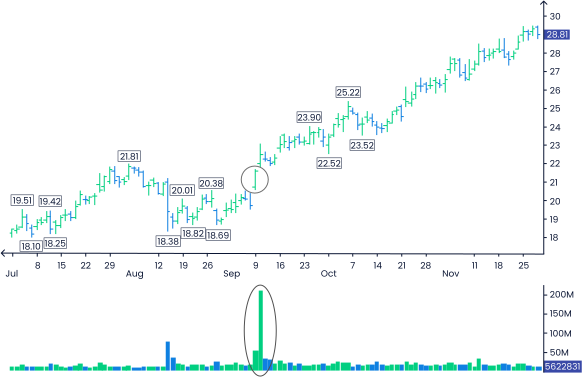
Position sizes creep up, like 2% risk to 5% per trade, breaching rules. Patterns ignore analysis, trading against trends or during low-volume Asia sessions.
Data from Myfxbook communities shows overtraders have 30-50% more trades monthly, with Sharpe ratios under 0.5 versus 1+ for pros. Choppy equity curves signal this, flatlining despite volatility.
Rhetorical question: does your broker statement show clustered losses? That’s a pattern. Set alerts for 5+ trades/day to pause. These indicators make overtrading obvious in hindsight, but real-time checks prevent it.
What Causes Overtrading Among Forex Traders?
Main causes of overtrading are emotional impulses, high leverage temptation, and 24/7 market access leading to unplanned frequency. To understand this better, let’s dig into the triggers.
How Does High Leverage in Forex Lead to Overtrading?
High leverage in Forex leads to overtrading by allowing large positions with small capital, amplifying impulses and encouraging frequent risky bets. Brokers offer 1:500 or more, so $100 controls $50,000. A good signal tempts oversized entries, but small reversals wipe margins.

This creates a cycle: win big, leverage more; lose, chase with bigger sizes. Without 1-2% risk rules, accounts blow fast. FCA reports show 70% of retail traders lose due to leverage misuse.
For example, on GBP/JPY, 200-pip swings with 1:100 mean quick calls or outs. Overtraders add to losers, averaging down. Limit leverage to 1:30 for EU brokers or self-cap at 1:50.
Psychologically, it feels like free money, but volatility like Brexit spikes punishes it. Calculate: at 1:500, 0.2% move against you equals 100% loss on margin. Stick to micro-lots early. This root cause demands strict sizing from day one.
Why Do Emotions Cause Overtrading in 24/7 Forex Markets?
Emotions cause overtrading in 24/7 Forex markets by constant access fueling FOMO, boredom, and stress from non-stop opportunities. No closing bell means London open tempts after NY fatigue. You trade Asia ranges impulsively.
FOMO spikes on Twitter hype or pair breakouts; greed follows wins. Boredom in flat markets leads to forcing trades. Studies like those from the Journal of Behavioral Finance note 24-hour access doubles emotional trades.
Stress builds from losses, prompting revenge. Weekends replay trades, priming Monday overcommitment. Counter with scheduled sessions, say 8-12 GMT only.
Picture this: USD/JPY news at 3 AM, you trade sleepy. Emotions override plans. Use apps like TradeInterceptor for alerts, not constant watching. Mastering this cuts causes at the source.
What Are the Effects of Overtrading on Forex Trading Performance?
Effects of overtrading on Forex performance include rapid account drawdowns, mounting commissions, and psychological burnout. In detail, these hit hard and fast.
What Short-Term Effects Does Overtrading Have on Forex Accounts?
Short-term effects of overtrading erode Forex accounts through immediate losses, high commissions, and widened spreads from poor timing. One session of 10 bad trades at 1% risk each means 10% gone, plus $5-10 fees per round-turn.

Spreads cost more on rushed entries, say 3 pips vs. 1 on majors. Slippage during volatility adds up. Brokers like IG data shows overtraders pay 2-3x fees proportionally.
Margin calls hit quick with leverage, forcing closes at lows. You miss good setups recovering. Weekly, drawdowns reach 15-20%, halting trading.
For instance, scalping 50 trades/day on EUR/GBP racks $50 commissions alone. Short-term, equity drops sharply, confidence dips. Track via MT4 tester to see patterns.
What Long-Term Effects Does Overtrading Cause for Traders?
Long-term effects include blown accounts, chronic stress leading to burnout, and shattered trading confidence. Repeated drawdowns compound; 20% loss needs 25% gain to break even, snowballing to zeros.

Burnout brings insomnia, obsession, quitting jobs. Confidence erodes, paralysis sets in on good trades. EU stats: 75% quit within two years from such habits.
Skills stagnate without plan adherence; you learn bad patterns. Relationships suffer from screen time. Recovery takes months rebuilding demo habits.
Ask yourself: after months, is your curve up? No? Overtrading caused it. Long-term, it turns passion into pain, but stopping rebuilds sustainably.
How Can Forex Traders Avoid Overtrading?
Forex traders avoid overtrading with a strict trading plan, daily limits, and mandatory breaks, preserving capital and mindset. Let’s see practical steps.
What Risk Management Rules Prevent Overtrading?
Risk management rules like 1% max risk per trade, daily loss limits, and fixed position sizes prevent overtrading. Start with 1% rule: on $10,000 account, risk $100 max per trade via stop-loss distance.

Daily limit: stop after 3% loss or 5 trades. Use calculators in MT5 for sizing. Always set stops, never move them.
Position sizing: base on volatility, ATR-based stops keep uniform risk. No pyramiding without profits.
1. Define rules in plan: 2-4 trades/day max.
2. Pre-market checklist: news, bias, setups.
3. Post-session review: log adherence.
Brokers enforce via account settings. This framework blocks impulses, data-backed by prop firms yielding 5-10% monthly.
How Does a Trading Journal Help Stop Overtrading?
A trading journal stops overtrading by tracking patterns, emotions, and adherence, building self-awareness through weekly reviews. Log every trade: entry/exit reasons, size, P&L, feelings.
Use Excel or Edgewonk: columns for FOMO score, plan match. Review Sundays: count overtrades, adjust.
It reveals triggers, like post-loss spikes. Quantify: if 60% impulsive, cut screen time.
For example, note “Entered NZD/USD on hunch, lost 1.5%.” Patterns emerge, rules tighten.
Rhetorical: seeing 20 bad trades/month changes habits? Yes. Journals turn data into discipline, long-term edge booster.
Related Questions About Overtrading in Forex
Related questions about overtrading in Forex cover distinctions from day trading, emotional ties to revenge trading, FOMO’s influence, contrasts with undertrading, automation’s role in prevention, recovery tactics, and effects on prop firm challenges.
Furthermore, these inquiries reveal how overtrading connects to broader trading psychology and risk management.
What Is the Difference Between Overtrading and Day Trading in Forex?
Overtrading involves executing too many trades driven by impulses, emotions, or poor discipline, often leading to higher costs and losses without a clear edge. Day trading, by contrast, is a deliberate strategy where traders open and close positions within the same day to capitalize on short-term price movements, using predefined rules like technical indicators or news events. The key difference lies in frequency driven by compulsion versus frequency as part of a structured plan.

You’ll notice overtraders chase every minor fluctuation, ignoring risk limits, while day traders set daily trade caps, such as 5-10 setups based on high-probability patterns like breakouts on EUR/USD. Data from broker reports shows overtraders average 20+ trades daily with win rates below 40%, compared to day traders’ 60-70% efficiency on fewer, quality entries. Have you ever wondered why some high-frequency traders succeed while others fail? It’s the strategy backbone.
This comparison highlights discipline as the separator.
- Overtrading racks up spreads and commissions without edge, eroding capital by 2-5% per session.
- Day trading employs tools like stop-losses at 1% risk per trade and profit targets at 2:1 ratios.
- Successful day traders journal trades for review, unlike overtraders who skip reflection.
How Is Overtrading Related to Revenge Trading in Forex?
Overtrading often evolves into revenge trading, where a trader, after a loss, ramps up position sizes or trade volume to “recover” quickly, fueling a vicious emotional cycle. Revenge trading is a subset of overtrading, triggered by the urge to erase drawdowns, like doubling down on GBP/JPY after a stop-out. Both stem from loss aversion bias, where pain from losses feels twice as strong as gains, per prospect theory from Kahneman and Tversky.

In practice, an initial bad trade sparks overtrading, then a string of losses ignites revenge mode, with traders ignoring their plan. Studies in trading psychology journals note 70% of retail Forex accounts suffer from this loop, turning a 1% loss into 10% wipeouts.
Understanding this linkage helps break the pattern early.
- Spot early signs like increasing trade sizes post-loss.
- Pause trading after two consecutive losers to reset mindset.
- Use fixed risk rules, such as 0.5% per trade, to limit escalation.
What Role Does FOMO Play in Forex Overtrading?
FOMO, or fear of missing out, acts as a primary psychological trigger in Forex overtrading by pushing traders into impulsive entries during volatile moves, like chasing Bitcoin crossovers into Forex pairs. It creates urgency, overriding analysis, as traders see others profiting on social media or live feeds and jump in late, often at peaks.

Psychological research from the CFA Institute identifies FOMO as activating the brain’s reward center, similar to gambling, leading to 30-50 extra trades weekly. For instance, during NFP releases, FOMO drives entries on USD pairs without confirmation, resulting in reversals.
Traders combat this by waiting for pullbacks.
- Delay entries by 15-30 minutes post-news to avoid herd mentality.
- Track FOMO episodes in a journal to recognize patterns.
- Set “no-trade” zones during high-volatility hours unless setups align.
How Does Overtrading Compare to Undertrading in Forex Markets?
Overtrading means excessive action that burns capital through fees and errors, while undertrading is the opposite: missing opportunities due to excessive caution, leading to opportunity costs and stagnant growth. Both imbalance discipline, but overtrading destroys accounts faster via drawdowns, whereas undertrading caps profits, like forgoing 20 pips daily on AUD/USD trends.

Broker analytics reveal overtraders lose 15-25% monthly from volume, undertraders gain only 5% by sitting out. The sweet spot? Balanced trading with 3-5 quality setups daily.
Why choose extremes when balance wins?
- Overtrading inflates slippage in fast markets like news.
- Undertrading ignores mean reversion edges in ranging pairs.
- Aim for 1-2% weekly targets with selective entries.
Can Automated Trading Tools Prevent Overtrading in Forex?
Yes, automated tools like Expert Advisors (EAs) on MetaTrader 4/5 and algorithmic bots prevent overtrading by enforcing strict rules, such as maximum daily trades or drawdown halts, removing emotional interference. EAs backtest strategies on historical data for pairs like EUR/USD, executing only when conditions match, like RSI divergences.

Niche solutions like cTrader cBots or TradingView Pine Script algos limit trades to 5 per day, boosting win rates by 15-20% per Myfxbook data. They shine in scalping, avoiding manual FOMO.
Integration requires customization.
- Code EAs with volatility filters to skip choppy sessions.
- Monitor via VPS for 24/5 operation without babysitting.
- Backtest monthly to refine parameters like trailing stops.
What Are Advanced Recovery Strategies After Overtrading Episodes?
Advanced recovery starts with a full trading halt for 7-14 days, followed by micro-account rehab using demo simulations and psychological resets like mindfulness to rebuild discipline post-overtrading. Focus on account drawdown analysis via tools like Edgewonk journals.

Post-incident, scale position sizes to 0.1% risk, trading only one pair like EUR/USD for pattern mastery. Therapy apps like TraderSync aid mindset shifts.
Recovery demands patience.
- Review loss trades for patterns, deleting emotional entries.
- Rebuild with 20-demo trade streaks at 60% win rate.
- Partner with mentors for accountability checks weekly.
How Does Overtrading Impact Forex Prop Firm Challenges?
Overtrading sabotages prop firm challenges by exceeding daily loss limits or trade count rules in evaluations, like FTMO’s 10% drawdown cap or The5ers’ 5-trade minimum consistency breach. Firms fund disciplined traders, so overtrading flags inconsistency, failing phases.
In FundedNext or FTMO, overtraders hit 50-trade days versus required 3-5 quality ones, voiding payouts. Stats show 80% of challenge failures tie to volume abuse.
Succeed by mimicking funded styles.
- Stick to 3 trades daily in simulations.
- Prioritize profit factor above 1.5 over quantity.
- Use prop rules as personal guidelines pre-challenge.